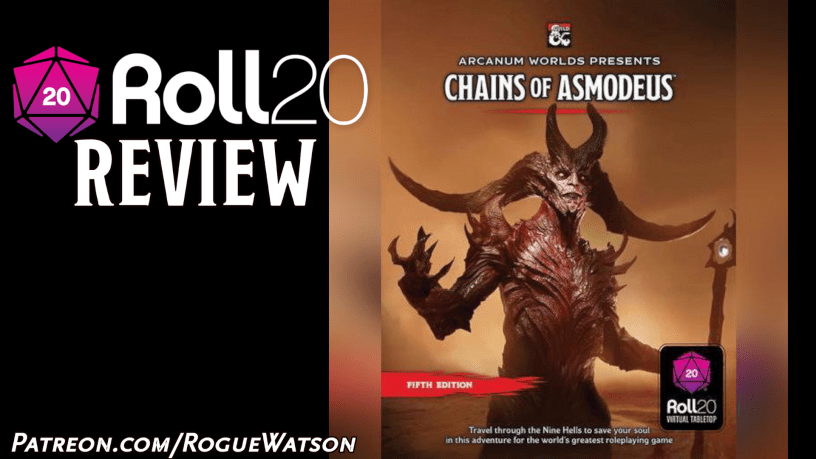
A review copy of the module was provided. Read more Roll20 Reviews and watch the video reviews on my YouTube channel.
Support my content via Patreon.
Designed by: Arcanum Worlds
From the design team behind Odyssey of the Dragon Lords comes a new high-level adventure that takes place entirely in the Nine Hells.
Chains of Asmodeus‘ campaign is overly linear and lacks smaller battle maps, but includes a hellish amount of content surrounding all nine layers, and a soul-saving quest that ties directly into every player characters’ personal story.
The following is included in the Chains of Asmodeus bundle on Roll20 ($29.99):
-
- Chains of Asmodeus module
- Level 11-20 adventure in 12 chapters
- 24 full color maps
- 3 5-ft square maps
- 2 “extra large” 5-ft square maps
- 19 regional maps
- Over 175 magic items (only a handful /w pics)
- Over 100 NPC and monster tokens (most w/ art)
- Over 30 player art handouts
- 10 Lost Souls (NPCs) and 9 Souls of the Damned (PCs)
- Over 25 rollable tables and macros.
- Chains of Asmodeus Art Pack
- 40 art handouts
- Over 100 monster, NPC, and PC tokens
- Chains of Asmodeus Compendium
- Over 50 new monster statblocks, including 11 archdevils
- Over 20 infernal magic items
- Corruption table
- Chains of Asmodeus module
Unlike Odyssey of the Dragon Lords, which used its own universe (published by Modiphius Entertainment), Chains of Asmodeus is published by Wizards of the Coast and uses the D&D IP, including the Forgotten Realms and the Nine Hells, which are themselves heavily based on Dante’s Inferno and Christian mythology.
Chains of Asmodeus is also available via PDF and print-on-demand via the DMs Guild.
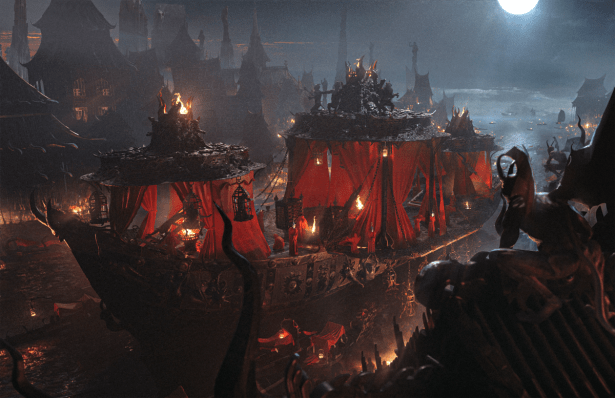
If you were annoyed by the relatively short jaunt through Avernus in Baldur’s Gate: Descent into Avernus, you won’t be disappointed here. At nearly 300 pages and 12 chapters, Chains of Asmodeus covers all nine layers, from Avernus to Phlegethos to Nessus.
The story begins during character creation. Players can choose existing level 11 characters (probably coming from any every other 5e campaign), or create new heroes. During character creation, they must also select a damned soul that needs rescuing — or their own.
Lost Souls are important NPCs in the PCs lives that have been killed, and due to their surprising dark deals, have their souls sent to one of the Hells.
Alternatively, a PC can select their own soul as having been taken, and their existence a temporary resurrection in order to steal it back. Each souls is being tormented in a specific way, on a specific layer.
It’s an intriguing start that immediately creates compelling, personal stakes for every player character. Bonus points if the DM can tie it into slain NPCs from a previous campaign!
The party must also select a group patron from one of three choices, representing good, neutral and evil. The group patrons also have reasons to send the party to Hell (such as saving celestials, or acquiring infernal artifacts). They offer unique buffs and services to the party, and help set them on their path toward a powerful head priest of Kelemvor, Koh Tam.
Koh Tam is the all-important NPC that essentially narrates and guides the party through all nine layers with his handy plane-shifting barge. Through each layer (and chapter) of the adventure, Tam guides the party along the River Styx, locating lost souls and patron objectives.
In fact, during the first chapter, Koh Tam is willingly possessed by an arch devil in order to reveal the location of all the objectives!
Thus, Chains of Asmodeus is not unlike a literal amusement park ride as the party sits in their boat and are guided through the exotic layers of Hell.
It’s, well, linear as hell.
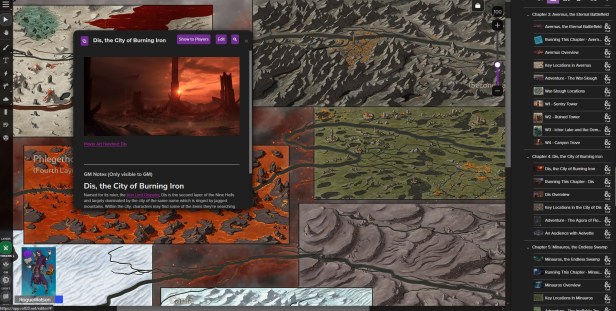
Each layer has its own chapter, overview, key locations, and wonderful regional map, as well as a cool overarching map that shows each layer connected via the river.
To keep the party from wandering off to every corner of each layer, the adventure centers each sought soul and object in a single adventure location in that region.
Dis, the urbanized second layer, features the Agora of Floating Knives, a floating market that caters to lots of non-devils, and features arenas, theaters, and shopping.
The fiery realm of Phlegethos has an elemental preserve, where a demon lord offers sports hunting for powerful elemental creatures (with the party ending up as the hunters, the distractors, or the hunted!). The frozen wastes of Cania has a mine full of frozen giants, while Maladomini focuses on a ruined city where multiple gangs fight for territory and control.
These adventure locations are incredibly varied, and show off how different and diverse each layer can be.
On the other hand, none of them are dungeon crawls, which I find hugely disappointing.
Dungeon crawls are the important protein dish of the D&D campaign, and translate best to a virtual tabletop. But here we’re left with slightly smaller regional maps, and almost no maps which are correctly sized for 5-ft combat.
It’s astonishing that 10 years after D&D 5e’s release, we’d get a major release with almost no usable battle maps. Especially for a VTT, this creates a huge amount of work for the DM to create unique battle maps for the many encounters and scenarios this adventure throws down.
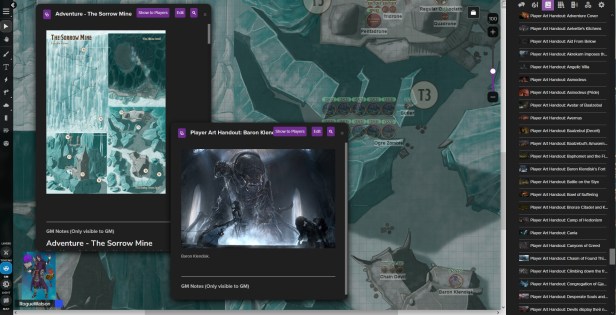
All of the adventure locations feature ample opportunities for combat and role-playing, and temptations for corruption, which is Asmodeus’ true goal.
But make no mistake, Asmodeus isn’t Strahd, or Raphael from Baldur’s Gate 3. He doesn’t show up until the very end, and even then it’s entirely possible (and probably preferable) for the party to avoid him entirely.
There are only two scripted events that remind the party that they’re not on their own little boat tour of hell. Detailed in chapter 11, they’re both nautical attacks that assault the party’s barge: an infernal submersible sent as revenge from Baalzebul aiming to kill, and an infernal warship sent by Asmodeus looking to capture.
They’re awesome action set-pieces, and also the closest things this adventure has to a dungeon crawl.
In the end, the party has to make it to the lowest level in order to truly save the souls and annul the contracts they made. There’s a dark twist where the DM keeps track of each player’s corruption (usually through tempting with new infernal magic items), and if a PC’s corrupt is too high, they cannot be redeemed, and their only hope is to serve Asmodeus after they die.
Otherwise there’s no big climax or boss battle, and thanks to Koh Tam’s magic barge, they can simply plane shift their way out of all nine layers.
Creating a compelling campaign in Hell is a daunting task, particularly when you want to feature all nine layers. Although Chains of Asmodeus fails to tell an interesting story outside of the PCs’ personal stakes (which would be largely player-driven), it offers way more Nine Hells-content than anything else I’ve seen from Wizards of the Coast, or the DMs Guild.
Pros:
- A tier 3-4 adventure that runs though all nine layers of Hell.
- Excellent regional maps for each layer, with varied adventure locations.
- Multiple options for important NPCs or PCs themselves as damned souls in need of saving.
- Corruption tracker makes choices matter in the end.
Cons:
- Simplistic story.
- Lacks good dungeon crawls.
- Very few normal 5-ft square maps.
The Verdict: Chains of Asmodeus is Dante’s Inferno by way of D&D: a mostly linear tour through one of the most exotic and feared settings of the Realms.
A review copy of the module was provided. Read more Roll20 Reviews and watch the video reviews on my YouTube channel.
Support my video work via Patreon.
 RogueWatson
this is a fair review of the adventure.
It’s more of a cruise down the Styx rather than a real story with strong links between each step. It’s a “then this happens” structure rather than a “because this happened before, now this happens “.
I’m struggling with preparing for my last session, which will take plenty of homebrewing to resolve in a satisfying way.
LikeLike