A review copy of the module was provided. Read more Roll20 Reviews and watch the video reviews on my YouTube channel.
Support my content via Patreon.
Designed by: Wizards of the Coast
I played Planescape: Torment back in the day (over 20 years ago, wow), during that Golden Age of cRPGs in the late 90s/early aughts. My teenage ass never finished it, but exploring an exotic city-nexus at the center of a wild multiverse was incredibly memorable, and the story is still considered one of the best in gaming to this day.
While the new 5e Planescape adventure has some fun nods to the classic cRPG, I found it a bit underwhelming, even if the overall bundle offers some wonderful content for exploring Sigil and the surrounding Outlands.
The following is included in the Planescape: Adventures in the Multiverse Roll20 bundle ($49.99):
-
- Turn of Fortune’s Wheel module
- 3 part adventure, organized in 15 chapters (levels 3-10, plus jump to 17 for the finale)
- 11 5-ft, fully colored maps
- 2 regional maps (Sigil, Outlands)
- Over 120 monster sheets and tokens (+over 20 named NPCs)
- Over 50 magic item handouts (9 with pictures)
- Over 30 player art handouts
- Over 20 rollable tables and macros
- Sigil and the Outlands (compendium)
- 2 player backgrounds
- 7 feats
- 2 spells
- 3 magic items
- Sigil Gazetteer
- 12 factions of Sigil
- 16 Gate-towns
- Morte’s Planar Parade (compendium)
- Over 50 new monsters
- Planar influence customization options
- D100 planar encounters
- Art Pack
- Over 200 monster, NPC, and PC tokens
- Turn of Fortune’s Wheel module
Like last year’s Spelljammer: Adventures in Space, the Planescape 5e release features three smaller books. Sigil and the Outlands is the three chapter sourcebook, including new player options. Morte’s Planar Parade is the monster book courtesy of everyone’s favorite floating skull, and Turn of Fortune’s Wheel is the new adventure book, featuring a campaign that spans levels 3-10 (with a Tier 4 jump at the end).
I’ll primarily talk about the adventure, but it’s obviously worth covering the other two books.
Compared to Spelljammer’s Astral Adventurer’s Guide, Sigil and the Outlands doesn’t have as many exciting player options. No space hippos or blob-folks, for example. Some new backgrounds, feats, a few magic items. Nothing particularly interesting.
Thankfully the other two chapters, aimed squarely at DMs, are much better.
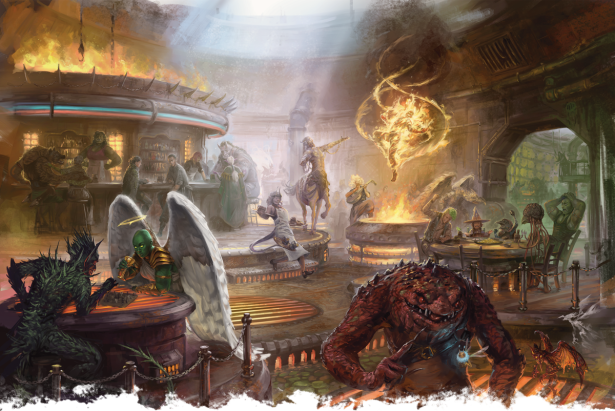
Sigil, aka the City of Doors, aka the coolest damn super-fantasy city melting pot you can imagine, is detailed in chapter two, including portals, wards, factions, adventure hooks, and encounter tables, with some suitably inspiring, gorgeous artwork to back it up.
Grab a magical tattoo in the crime-ridden Hive Ward, buy a fireforged weapon from an efreeti Doomguard, gamble at the Fortune’s Wheel casino, and discover portals to other worlds in the strangest of places.
Chapter three is all about the Outlands that surround Sigil — namely the 16 gate-towns that border the chaotic conflux of worlds and portals. Each gate-town leads to a major plane of the multiverse, including Mechanus, Acheron, Hades, Mount Celestia, and The Nine Hells, with each town reflecting their themed universe.
With their own gregarious leaders and adventure hooks, it’s all very reminiscent of the demiplanes from Van Richten’s Guide to Ravenloft, and I mean that as a compliment.
The monster book adds over 50 new monsters, including new modron variants and githzerai statblocks, as well as time-dragons.
My favorite new additions are the dog-folk Hound Archons, the supremely creepy flying-head Vargouilles (which feature in a particularly memorable scene in the adventure), and the sleek, robotic-looking Rilmani who help maintain stability in the Outlands.
Oh, and the Eater of Knowledge, which is like if you combined an Intellect Devourer with the Hulk!
The adventure is always a big selling point for any 5e release. I’m sorry to report that it’s not my favorite. Despite the cool setting and the amazing start, it fails to maintain an interesting story throughout, and serves more as a flimsy excuse to explore as much of the Outlands as possible.
Turn of Fortune’s Wheel begins with the adventurers waking up on a slab in the mortuary in the middle of Sigil. They were dead a moment ago, now they’re not. Also there’s a talking skull named Morte there to greet them.
Wait a minute, that’s exactly how Planescape: Torment begins!
Sadly Morte isn’t written to accompany the PCs. He’s waiting for someone else, another nod to the video game.
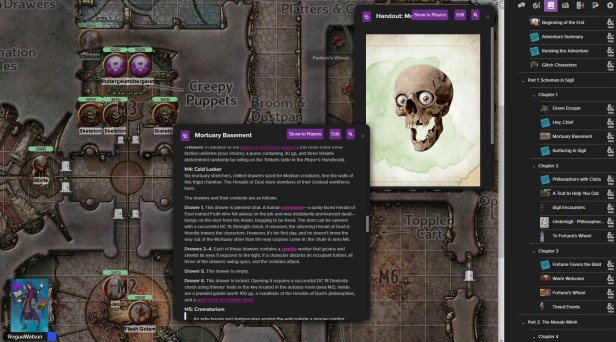
The Mortuary Basement is an awesome little dungeon crawl, designed to be both hilariously weird and very deadly, between flesh golems, incinerator hallways, corpse-chutes, and an irritable demi-lich.
But if a PC dies, it’s not the end. They’re all experiencing multiversal glitches, hence why they spawned here in the first place.
If a PC dies during this adventure (and most likely, in this first dungeon), they simply respawn as a different variant. The DM can choose to reveal this secret before the adventure begins (prepping some additional characters) or drop it as a unique shock after the first death.
It’s an awesome start and an intriguing story hook. Sadly the story never quite reach this initial height.
After leaving the basement, the party runs into a few encounters, and are ushered to the casino of Fortune’s Wheel, and the arcanoloth Shemeska, who pledges to help them.
She needs the party to track down a rogue modron named RO4M. But in order to find it, they must repair his mimir, a floating skull that acts like a tour guide. Seems like we could’ve just used Morte for this, oh well.
The RO4M’s mimir is missing information from seven specific gate-towns. Thus, Act 2 has the party venturing out into the Outlands to explore each of these towns and gather the requisite information.
Already we have a weak plot thread. The party still has no real clue what’s going on, and we’ve barely spent any time in Sigil before we have to leave. The Outlands aren’t nearly as interesting as the City of Doors, and the main quest simply involves visiting each of those seven towns, then basically moving on to the next.
Of course, each town has a quest the players can do, though most of them are entirely optional (I think only Crust’s is required, as the party becomes trapped in the prison-town).
The town quests do offer a nice variety of tasks and missions, from defeating a giant monster in Glorium to defending the town of Rigus from invading forces, and investigating a rash of missing persons in Excelsior.
But these non-linear chapters are much more wide than deep. If we had to go into the Outlands, I would’ve preferred only two or three cities, with multiple quests and people to interact with, and a way to actually move the plot forward, like perhaps chasing the modron as it leaves behind clues.
In fact, I found the random Outlands encounters (a baseball game between angels and demons, and a repeated out-of-time encounter with a time dragon) much more compelling than most of the town quests.
Also, I really enjoy dungeon crawling in D&D, and there really aren’t any dungeon crawls after that first basement escape. The casino in Act 1 is awesome-looking but mostly wasted without any big cool scenes. A single walking castle serves as a nice little dungeon crawl full of fiends (and the party can then commandeer it for their mode of transportation) at the start of Act 2, but it’s also very linear.
Near the end of Act 2 the party finally tracks down the modron, who reveals that the arcanoloth is actually behind the glitches. The same person who sent them on the quest, and could’ve easily had them killed (again), instead of allowing them to gather a ton of XP and loot!
She’s also behind a weird modron abduction plot which becomes the actual finale.
After using the modron’s portal to return to the casino in Sigil, the party confronts Shemeshka and defeats her. They regain their memories and ascend from level 10 to level 17.
Too many 5e adventures casually boost the PCs’ power level at the end so they can take on more powerful (and unearned) threats, such as Acererak in Tomb of Annihilation, or the ancient blue dragon from Storm King’s Thunder.
At least, here the power boost is natural, and makes sense in context of the story.
But wait, we already defeated the story’s not-so-big bad? Isn’t this the end?
Nope, we still have one final, weird chapter.
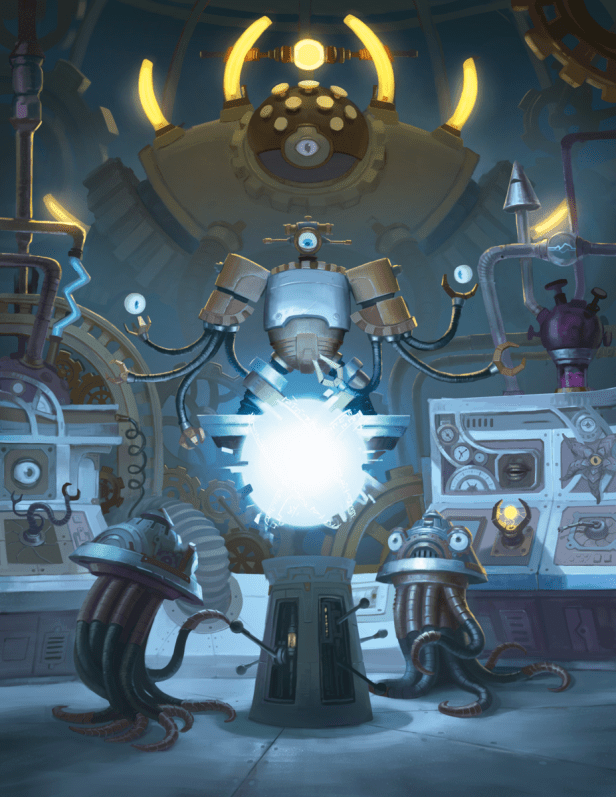
As newly minted level 17 PCs, they can now save the modrons. Did you know this story was all about saving modrons from The Great Modron March?
Anyway, they’re trapped in the twisted realm of beholders, prompting the party to enter and defeat a series of nasty encounters, before taking on the final boss, some sort of corrupted modron planar thing.
As you can tell, the finale falls a bit flat for me. The only villain is barely a villain, and the bulk of the adventure is little more than a series of side quests, offering a thin excuse to make a tour around the Outlands.
The good news is, the maps and artwork are incredible. Unlike Spelljammer’s adventure, these maps are fully detailed and colored, and look stunning in Roll20.
You won’t find many drab caves here, with the brightly colored casino, chaotic beholder realm, and amazing regional maps of Sigil and the Outlands. Easily some of the best 5e artwork I’ve seen outside the Magic: The Gathering tie-ins.
With awesome maps and a weak story, it’s kind of the opposite of the Spelljammer 5e adventure, Light of Xaryxis, though it does seem to have more content and more suitable world-building for DMs wanting to put in the work to craft a proper adventure worthy of Planescape.
Pros:
- Sigil and the Outlands is a comprehensive sourcebook bursting with useful information and fun story ideas.
- Turn of Fortune’s Wheel features a wonderful start, and a clever twist with “respawning.”
- The titular casino in the adventure is full of fun characters, events, and minigames.
- Morte!!
- Gorgeous full color map art.
- Roll20 tips page and dynamic lighting example page are hugely helpful for new users.
Cons:
- The adventure lacks a strong, central plot.
- Part 2 is a series of short, disconnected side quests of varying quality.
The Verdict: More than any other 5e adventure, the Planescape adventure embodies the strangers in a strange world archetype, but after its killer opening never quite finds its footing as a compelling story in D&D’s most exotic setting.
A review copy of the module was provided. Read more Roll20 Reviews and watch the video reviews on my YouTube channel.
Support my video work via Patreon.
 RogueWatson